Creating Outdoor Spaces That Feel Part of the Home in Heswall
A good patio should never look as though somebody simply chose a rectangle of paving and dropped it into the garden.
For many homeowners in Heswall, the patio is one of the most important parts of the outdoor space. It may be where the family eats during summer, where friends gather in the evening, where doors from a kitchen extension open onto the garden, or where a previously awkward slope is turned into somewhere genuinely useful.
At Wirral Flagging, we approach patios in Heswall as part of the overall garden rather than treating paving as an isolated surface. The right paving material matters, but so do levels, drainage, proportions, steps, borders and the relationship between the patio and the house.
A successful patio should feel as though it was always meant to be there.
Designing Around the Property
Heswall has an enormous variety of homes and gardens, which means the same patio design will not work everywhere.
A contemporary extension with large glazed doors might suit a clean porcelain patio with straight lines and large-format slabs. An older property surrounded by mature planting might look much better with natural sandstone or paving that has more colour variation and character.
The starting point should therefore be the property itself.
Brick colour, window frames, existing paths, boundary walls and garden planting all influence which paving will look right.
The size of the patio is equally important.
A patio that looks generous when empty can quickly feel cramped once a dining table, chairs, barbecue and planters are added. We prefer to think about how the space will actually be furnished before determining the final dimensions.
Porcelain Patios in Heswall
Porcelain has become one of the most popular choices for homeowners wanting a clean, modern garden.
Porcelain patios in Heswall work particularly well with contemporary extensions and renovated properties because the slabs provide a precise, consistent appearance.
They are available in a wide range of finishes, from pale stone effects through to slate greys and darker contemporary tones.
One of porcelain’s strengths is the ability to create a strong connection between the house and garden. Where similar tones are used indoors and outdoors, the patio can visually extend the living space beyond the doors.
However, porcelain is not simply another paving slab.
It needs the correct installation method, including a properly constructed base and suitable bonding products. Poor preparation can lead to loose slabs regardless of how expensive the paving itself may be.
Edges, cuts and joints also need to be finished carefully. Porcelain is precise by nature, so small installation mistakes can be much more noticeable than they would be with irregular natural stone.
Indian Stone for More Traditional Gardens
Not every Heswall property needs an ultra-modern finish.
For established gardens, Indian sandstone paving remains an excellent option.
The natural variation between slabs gives the patio more movement and character. Instead of every piece looking identical, subtle differences in colour and texture help the finished area feel more relaxed.
This can work particularly well in gardens containing mature shrubs, traditional brickwork or older boundary walls.
Indian stone is also highly versatile.
It can be laid in traditional mixed-size patterns or in simpler layouts for a more contemporary appearance. The surrounding edging and planting can completely change how formal or informal the finished patio feels.
For some homes, the slight imperfections of natural stone are exactly what make it the right choice.
When Levels Become the Main Design Feature
One of the most interesting challenges with patio installation in Heswall is dealing with gardens that change level.
Sloping gardens can initially appear awkward, particularly where the house sits significantly higher or lower than the main lawn.
But changes in level can actually create some of the best designs.
Rather than trying to flatten everything, it may be better to introduce separate terraces.
A patio immediately outside the house can provide space for dining, while steps lead to a lower lawn or second seating area. Retaining walls or sleeper features can define the different levels and make the garden feel more structured.
The crucial thing is planning.
Steps should be comfortable to use. Retaining structures need to be properly built. The finished levels must work with existing doors, fences and neighbouring boundaries.
Most importantly, water must still have somewhere to go.
Patio Drainage in Heswall
Drainage is one of the least glamorous parts of patio design, yet it is also one of the most important.
Once a garden area is paved, rain can no longer soak directly into the ground in the same way it would through lawn or planting.
The patio therefore needs carefully planned falls.
In many cases, the paving can be constructed so water naturally moves away from the house towards an appropriate drainage area.
Where levels or existing structures make that difficult, channel drainage may be required.
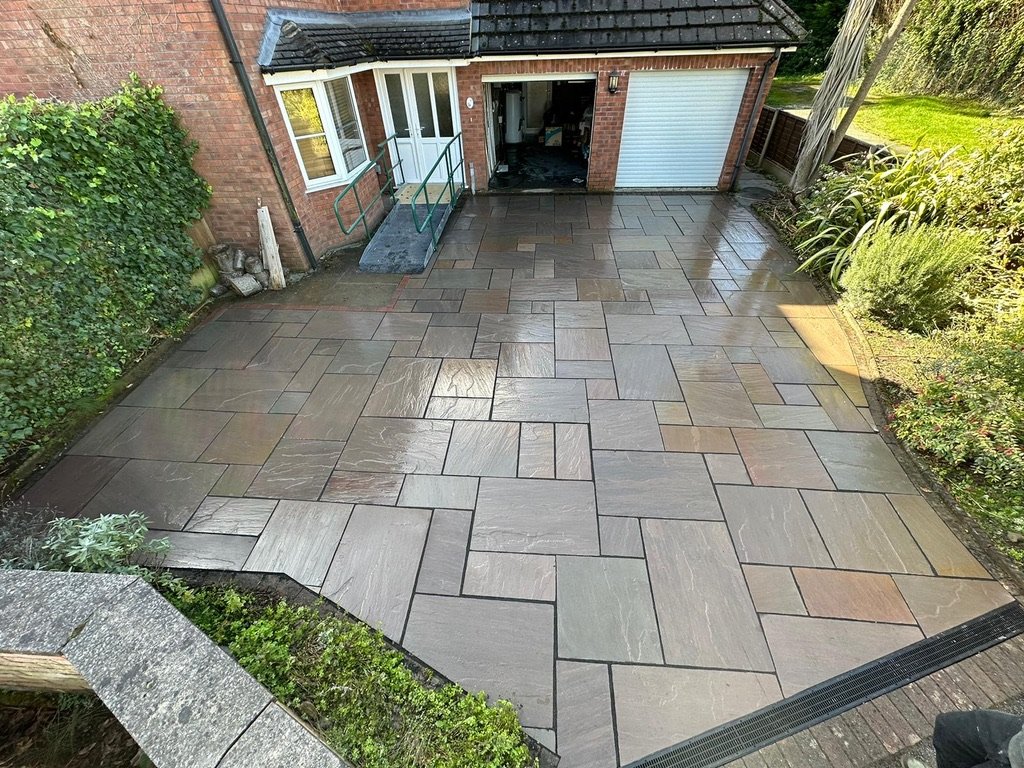
ACO-style channels can be incorporated beside the property, across doorways or at changes of level to collect surface water and direct it appropriately.
This is particularly important where large patio areas meet modern extensions with low thresholds.
A beautiful patio that sends water towards the house is not a successful installation.
Replacing an Existing Patio
Many of the patio enquiries we receive are not for completely new gardens.
They involve replacing paving that was installed years ago and has gradually deteriorated.
Typical problems include:
rocking slabs
sunken sections
cracked joints
standing water
weeds growing through failed joints
paving that slopes towards the house
small patios that no longer suit the way the family uses the garden
Simply replacing the visible slabs does not always solve these problems.
If the base underneath has moved or was inadequately prepared in the first place, new paving can eventually develop exactly the same faults.
A proper replacement patio may therefore involve removing both the old surface and unsuitable material beneath it before rebuilding the area correctly.
It can also be the ideal opportunity to change the shape or dimensions.
A patio designed twenty years ago may have been intended for two chairs and a small table. Modern outdoor living often requires substantially more space.
Paving Contractors in Heswall
When choosing paving contractors in Heswall, it is worth asking how the area will actually be constructed.
The finished paving is the part everyone sees, but much of the workmanship disappears underneath it.
Excavation depth, sub-base material, compaction, bedding, drainage, edge restraint and falls all contribute to how the patio performs over time.
An installation that looks perfect on the first day is not necessarily a good installation.
The real test comes after repeated winters, heavy rainfall and everyday use.
At Wirral Flagging, we believe the groundwork should receive as much attention as the paving itself.
That may mean more excavation on one garden than another, additional drainage, building retaining structures or spending extra time establishing the correct levels before the first slab is laid.
Every garden is different.
Patio Areas for Entertaining
If the patio is primarily intended for entertaining, layout becomes especially important.
A dining table needs sufficient room around it for chairs to be moved comfortably. Barbecues should not be squeezed into narrow corners. Routes from the house to the rest of the garden should remain clear.
Where space allows, it can be useful to create more than one zone.
A main dining area might sit close to the house, while a smaller paved seating area is positioned elsewhere in the garden to catch evening sun.
Materials can also be used to distinguish these areas without making them feel disconnected.
The same porcelain or sandstone can be continued throughout, perhaps with different edging or planting used to define each space.
Paving, Artificial Grass and Planting
A garden does not need to be entirely paved to become low maintenance.
Some of the most effective landscapes combine paving, artificial grass and planting.
The hard landscaping provides practical seating and walking areas. Artificial grass can introduce a softer green surface without creating another mowing job. Planting beds retain natural colour and seasonal interest.
The proportion between these materials is what matters.
Too much hard landscaping can make a garden feel stark. Too much lawn may leave insufficient usable seating space.
A well-designed patio should therefore complement the rest of the garden rather than dominate it.
Paths, Steps and Side Access
The main patio might receive most of the attention, but the connecting areas are often just as important.
A side path leading from the driveway, steps between garden levels or access to a shed can affect how practical the entire garden feels.
We often use paving projects as an opportunity to improve these routes.
Matching or complementary paving can create a much more coherent finish than treating every section separately.
In narrow side passages, drainage needs particular attention because there may be limited space for water to disperse naturally.
Block Paving in Heswall
While porcelain and natural stone are generally associated with patios, block paving in Heswall remains useful for several applications.
It can be particularly effective for:
driveways
entrance areas
garden paths
edging details
small courtyards
transitions between different surfaces
Block paving provides enormous flexibility because the individual units can follow curves and irregular shapes.
It also allows contrasting borders and patterns to be introduced where appropriate.
For driveway areas, the construction underneath must be designed for vehicle loads rather than normal pedestrian use.
Driveways in Heswall
We also undertake driveways in Heswall, where the priorities are slightly different from garden paving.
The surface needs to cope with vehicles, regular movement and turning forces.
Correct excavation and sub-base construction are therefore essential.
Drainage must also be considered carefully, particularly where the drive slopes towards the house or public highway.
A new driveway occupies a large proportion of the front of many properties, so appearance matters as well.
The best result is one that provides practical parking without looking disconnected from the style of the house.
Hard-Standing Bases for Sheds and Garden Buildings
Garden rooms, sheds and storage buildings also need proper foundations.
Placing a substantial structure directly onto unstable or damp ground can eventually result in movement and deterioration.
We can construct hard-standing shed bases in Heswall using appropriate sub-base and paving or concrete construction, depending on the structure being installed.
Where possible, the base should be considered alongside the rest of the garden design.
If a new shed is being positioned at the rear of the garden, for example, it may make sense to build the access path at the same time rather than treating the two jobs separately.
Choosing the Right Patio for Your Heswall Garden
The best patio is not necessarily the most expensive one.
It is the one that suits the house, garden and way the homeowners intend to use the space.
A modern porcelain patio may be ideal for one property. A traditional sandstone terrace may be perfect for another.
The important questions are:
How much space is really needed?
Where does the sun fall?
How will people move through the garden?
What are the existing levels?
Where will rainwater go?
Which materials suit the property?
Answering those questions before installation begins usually produces a much better result than choosing paving purely because it looks attractive in a brochure.
Wirral Flagging – Patio and Paving Specialists in Heswall
Wirral Flagging provides patios, paving and landscaping in Heswall for projects ranging from small replacement patios to complete garden transformations.
Our work can include:
porcelain patios, Indian stone paving, traditional flagging, garden paths, steps, drainage, retaining features, block paving, driveways and hard-standing bases.
The focus is always on creating outdoor spaces that function properly as well as looking good.
Good paving is not simply about the surface you see.
It is about understanding the property, establishing the right levels, constructing a reliable foundation and choosing materials that make sense for the surroundings.
If you are considering a new patio in Heswall, replacing old paving or planning a larger garden redesign, Wirral Flagging can assess the site and provide a quotation based on what the project actually requires.
Patios Heswall Baskervyle Road - Lower Heswall
Case Study – Bespoke Flagging and Tree Edging on Baskervyle Road, Heswall
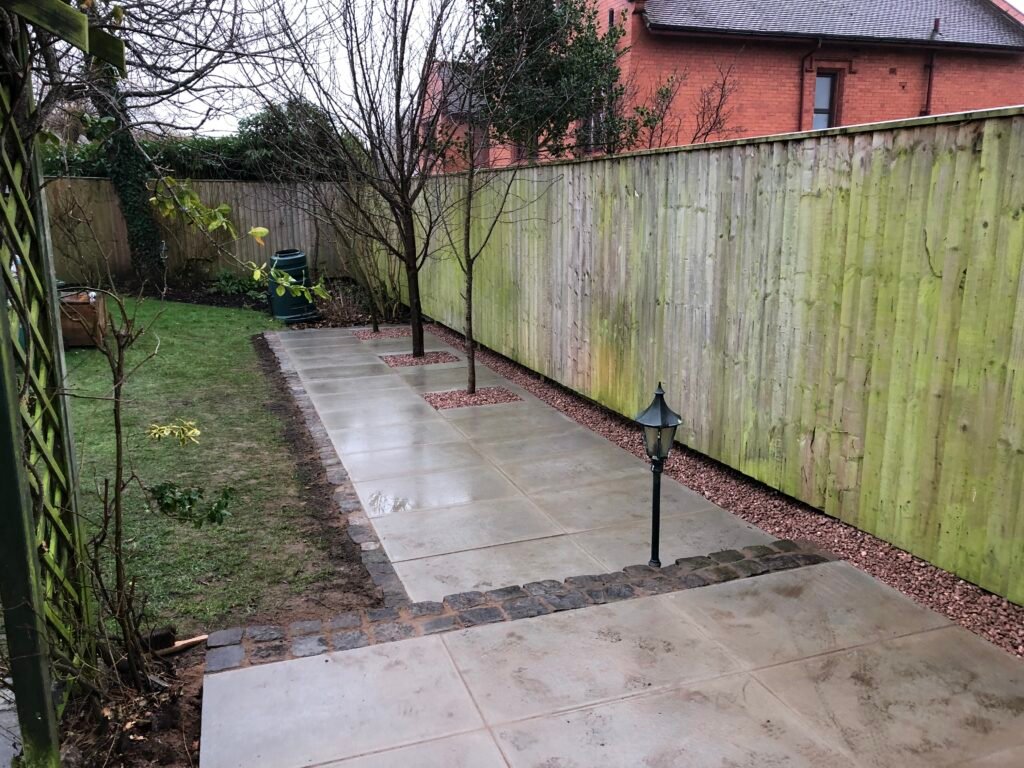
This project on Baskervyle Road in Heswall involved working within a mature, high-value garden where the landscaping already had plenty of character. The homeowners did not want a complete redesign. Instead, they wanted the existing garden improved with carefully installed flagging and neat edging around established trees, while preserving the mature feel of the property.
The setting demanded a more considered approach than a straightforward patio installation. Mature trees, established planting and existing garden features all needed to be respected, so the new paving had to look as though it genuinely belonged within the landscape rather than appearing newly added.
Working Around Established Trees
One of the main challenges was creating attractive paved areas around mature trees without making the garden feel overly hard landscaped.
The trees were important features and formed part of the character of this Heswall garden, so they were treated as design elements rather than obstacles.
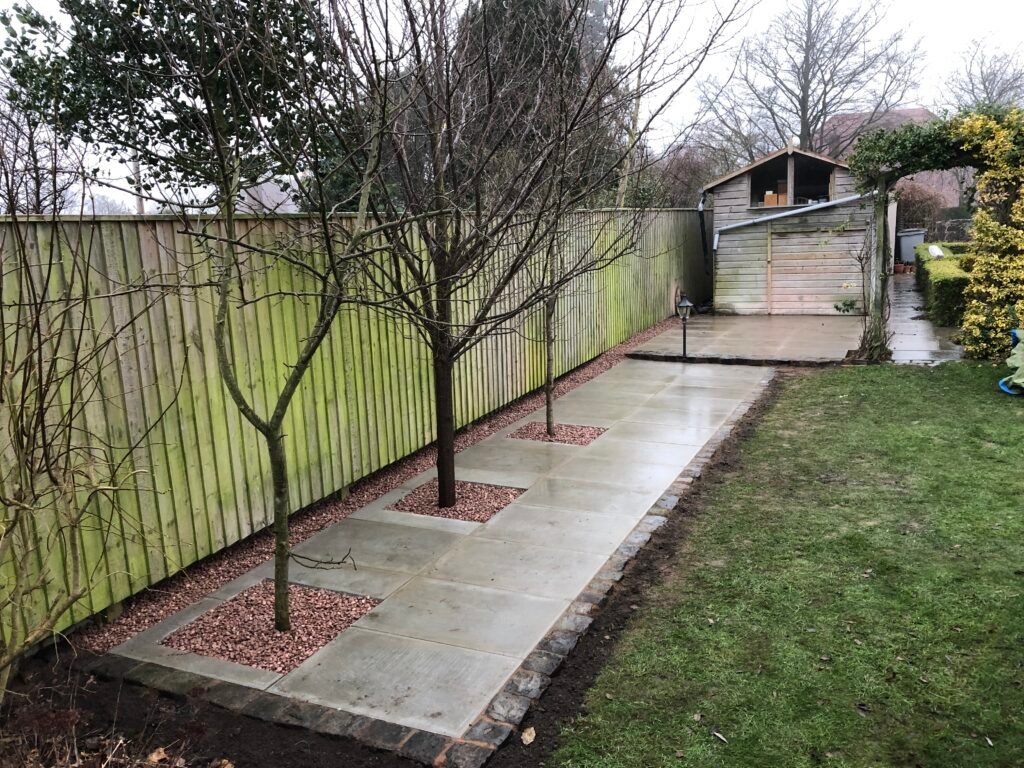
Careful edging was introduced around the tree bases to create clearly defined planting zones. This provided a neat transition between the paving and the natural areas of the garden while helping prevent the finished space from looking too rigid.
The curves and boundaries were planned carefully so that the finished paving complemented the shape of the trees and surrounding beds.
Preparing the Flagged Areas Properly
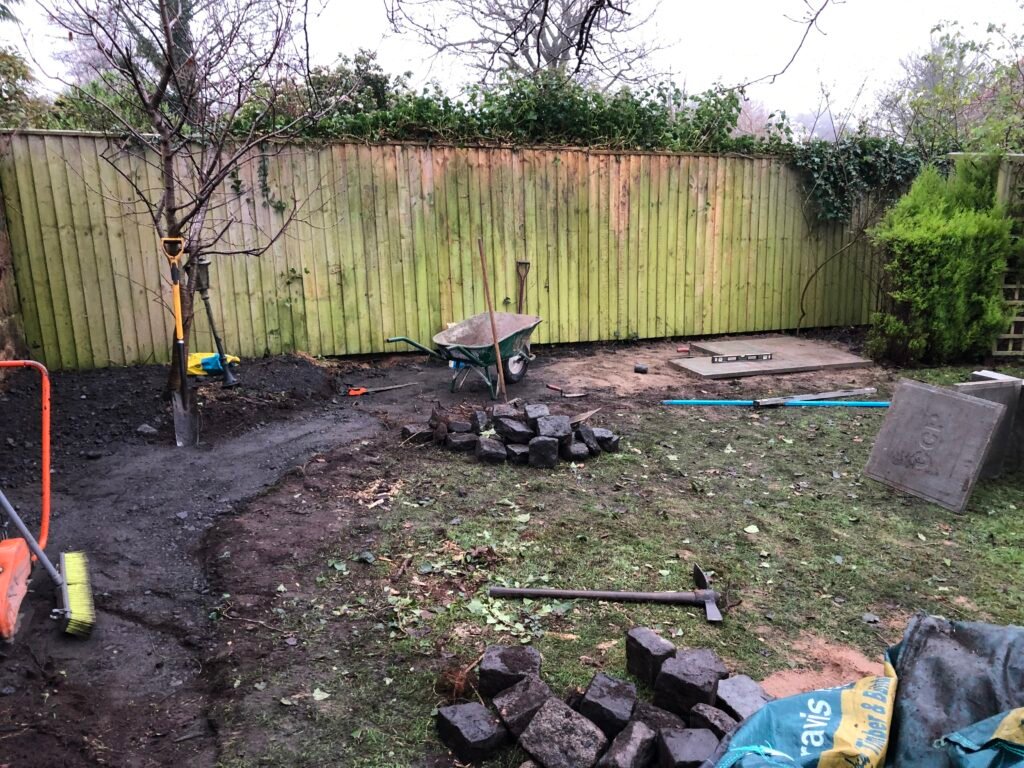
Before any flags were laid, the areas were excavated and prepared to the appropriate depth.
A properly compacted sub-base was installed to create a stable foundation, with levels checked carefully throughout the garden.
Working around mature planting requires particular attention because roots, existing borders and changes in level can all influence the way paving needs to be constructed.
The flags were then laid with consistent spacing and carefully finished joints. Particular care was taken around cuts and edges, where poor workmanship would have been especially noticeable in a high-quality landscaped setting.
Enhancing Rather Than Replacing the Garden
The objective was never to make the garden look brand new.
In fact, the opposite was true.
The best result for this Baskervyle Road property in Heswall was to introduce new paving that made the existing mature garden look even better.
The flagging created cleaner routes through the outdoor space and more usable areas, while the edging around the trees gave the planting greater definition.
The contrast between structured paving and established greenery worked particularly well. The new hard landscaping provided order and practicality, while the trees and mature planting ensured the garden retained its natural character.
A Finish Appropriate for the Property
Because the property sits in one of Heswall’s more established residential areas, attention to detail was particularly important.
The finished work needed to match the quality and character of the surroundings.
Rather than dominating the garden, the paving now sits comfortably within it. The tree edging looks deliberate and refined, while the new flagged areas provide practical, easy-to-maintain surfaces without sacrificing the established feel of the landscape.
The result is a garden that feels more organised, more usable and better defined, while still retaining the maturity and individuality that made it attractive in the first place.
Project Highlights
Location: Baskervyle Road, Heswall
Mature, established residential garden
Bespoke flagging installation
Existing mature trees retained as key garden features
Carefully formed edging around tree bases
New paving designed to complement existing landscaping
Existing levels and planting taken into consideration
Ground excavated and properly prepared
Compacted sub-base installed for long-term stability
Detailed cutting and finishing around irregular areas
Clean transitions between paving and planted sections
Improved pathways and usable garden areas
Mature character of the garden preserved
Hard landscaping introduced without overpowering the planting
Low-maintenance paved surfaces
High-quality finish appropriate for a prestigious Heswall property
Garden left looking more structured, refined and practical